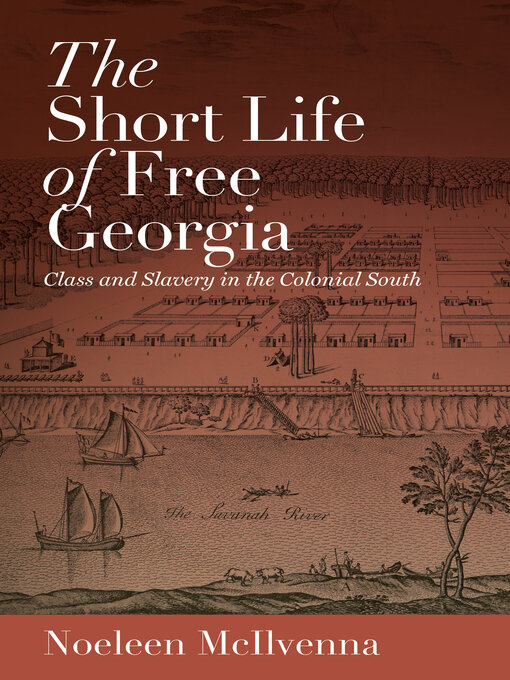
For twenty years in the eighteenth century, Georgia — the last British colony in what became the United States — enjoyed a brief period of free labor, where workers were not enslaved and were paid. The Trustees for the Establishment of the Colony of Georgia created a “Georgia experiment” of philanthropic enterprise and moral reform for poor white workers, though rebellious settlers were more interested in shaking off the British social system of deference to the upper class. Only a few elites in the colony actually desired the slave system, but those men, backed by expansionist South Carolina planters, used the laborers' demands for high wages as examples of societal unrest. Through a campaign of disinformation in London, they argued for slavery, eventually convincing the Trustees to abandon their experiment.
In The Short Life of Free Georgia, Noeleen McIlvenna chronicles the years between 1732 and 1752 and challenges the conventional view that Georgia’s colonial purpose was based on unworkable assumptions and utopian ideals. Rather, Georgia largely succeeded in its goals — until self-interested parties convinced England that Georgia had failed, leading to the colony’s transformation into a replica of slaveholding South Carolina.
- Available now
- New eBook additions
- New kids additions
- New teen additions
- Most popular
- Try something different
- Dining Al Fresco
- See all ebooks collections
- New audiobook additions
- Family Road Trip Audiobooks
- Available now
- New kids additions
- New teen additions
- Most popular
- Try something different
- Family Reading Time
- Listen Up: Great Narrators
- See all audiobooks collections
- Let's Get Cooking!
- Celebrity Magazines
- News and Politics
- Lifestyle Magazines
- All Magazines
- Popular Magazines
- See all magazines collections